

Macintosh SE/30 – A Compact Powerhouse in Late-1980s Computing History
Introduction: The little Mac that could (and did) everything
January 1989. Apple unveiled a computer that shattered expectations about what compact Macs could accomplish. The same all-in-one case that defined the Macintosh since 1984 now housed something different: a Motorola 68030 processor. That chip powered machines twice its size. Three times its price. This was the Macintosh SE/30.
For thousands of professionals and students and tinkerers, we think it qualified as a genuine revelation.
Apple priced the base model at $4,369 and delivered computing muscle in the most unassuming package imaginable. Nine-inch monochrome screen. Footprint smaller than most laser printers. Desktop publishing professionals wept with joy. Software developers abandoned expensive workstations.
The SE/30 was more than another product update. Apple believed computing power belonged to everyone, not locked in server rooms or sprawled across massive desks. Collectors today hunt for working units. These machines boot. They run. They matter.
The genesis and historical context
The spark
Late 1988 put Apple at a crossroads. The original Macintosh proved personal computers could be intuitive. Delightful, even. But the landscape shifted. IBM PC clones dominated offices everywhere. The original compact Macs (128K, 512K, Plus, SE) built tremendous loyalty, but their aging Motorola 68000 processors struggled with software that kept getting more demanding.
Apple’s response to professional demands had already succeeded brilliantly. The Macintosh II and its successors brought color graphics and NuBus expansion slots that transformed Mac capabilities. But these machines required desk space, external monitors, deeper pockets. Not everyone wanted that. Many users loved the compact Mac’s simplicity.
 One box. One power cable. Instant productivity.
The unavoidable question: could Apple bring serious power to its beloved compact form factor? Engineers at Cupertino set out to prove it.
The computing world before SE/30
Consider the compact Mac landscape of 1988. The Macintosh SE arrived in early 1987 with an expansion slot and more robust power supply. Reliable. Beloved. Under the hood sat the same 8 MHz 68000 processor that powered the original Mac from 1984.
Four years of software evolution had transformed what users expected.
Desktop publishing demanded faster layout rendering. HyperCard stacks grew complex. Scientists and engineers needed floating-point calculations without waiting minutes for results. The SE was adequate. Nobody called it fast.
Meanwhile, modular Macs with 68020 and 68030 processors blazed ahead. The price gap felt insurmountable for many users. Students and small business owners and home enthusiasts watched enviously from behind their aging compact screens.
Building something new
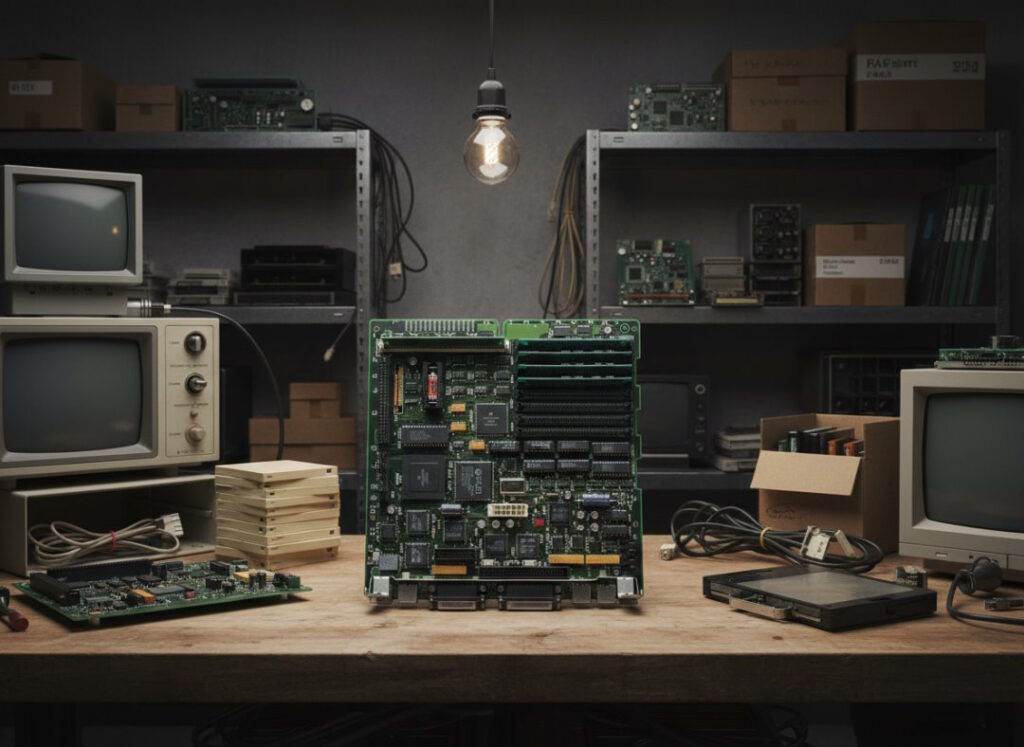 Apple’s engineers faced technical challenges. The compact Mac case left little room for additional components. Heat dissipation in such a confined space presented engineering hurdles. The existing SE logic board simply could not accommodate the 68030 and its supporting chips.
The solution was an entirely new logic board architecture. Apple engineers called it “Green Jade” internally. They crammed the 32-bit 68030 processor running at 15.667 MHz (commonly rounded to 16 MHz) alongside a dedicated Motorola 68882 floating-point unit. They redesigned the memory subsystem to support SIMM slots that could theoretically expand far beyond official specifications.
January 19, 1989. Apple announced the Macintosh SE/30 at Macworld San Francisco, alongside the Macintosh IIcx. The compact Mac faithful finally had their speed demon. Jean-Louis Gassee, then Apple’s president of products, called it “the ultimate compact Macintosh.”
He was not exaggerating.
Innovations and user experience
Desktop power in a compact shell
What made the SE/30 extraordinary was not any single component. The totality of the package mattered. The 68030 processor delivered roughly four times the performance of the standard SE. Applications that previously crawled now flew.
Aldus PageMaker rendered layouts in seconds instead of minutes. Microsoft Excel recalculated massive spreadsheets while you reached for your coffee.
The included 68882 FPU transformed scientific and engineering work. CAD applications and statistical analysis packages and 3D rendering tools suddenly became practical on a machine that sat quietly on your desk. Graduate students across America defended dissertations processed by their SE/30s.
Apple also included the SuperDrive as standard equipment. This 1.44 MB high-density floppy drive could read and write DOS-formatted disks. Cross-platform file exchange, previously requiring expensive solutions, worked straight out of the box. The SE/30 played well with others. Even IBM compatibles.
Memory expansion told maybe the most compelling story. Apple officially rated it for 8 MB (later increased to 32 MB). Resourceful users discovered the SE/30 could actually address 128 MB of RAM with third-party ROM upgrades or system extensions like MODE32. Most personal computers of that era shipped with 640 KB. This expandability was almost absurdly forward-thinking.
Physically, nothing dramatic changed. Same nine-inch monochrome CRT. Same Snow White design language with horizontal ventilation stripes. Same keyboard and mouse.
The experience transformed completely. Boot times shortened. Application launches quickened. Multitasking under MultiFinder became genuinely practical rather than an exercise in patience.
Cheers and jeers
Critical response bordered on ecstatic. MacUser awarded the SE/30 five mice (their highest rating) and called it “the compact Mac we’ve been waiting for.” Macworld praised its “breathtaking speed.” Sales confirmed the enthusiasm. The SE/30 became one of Apple’s best-selling compact Macs ever.
The machine found homes in universities and design studios and law offices and medical practices. Its reliability became legendary. Stories circulated of SE/30s running continuously for years without failure. System administrators deployed them as servers. Developers used them as primary coding machines.
Critics existed. The monochrome display felt limiting in an increasingly colorful computing world. The Macintosh II had introduced color two years earlier. Serious graphics professionals needed what the SE/30 could not provide.
The price stung for home buyers. $6,569 bought a fully loaded configuration with 4 MB RAM and 80 MB hard drive. We think that works out to roughly $16,000 adjusted for inflation.
The single PDS (Processor Direct Slot) expansion port limited upgrade options compared to NuBus-equipped Macintosh II machines. Third-party vendors offered accelerators and networking cards and even video output adapters. But you could only choose one. The compact form factor that charmed users also constrained them.
A more insidious problem emerged over time: battery leakage. The lithium backup battery soldered to the logic board would eventually corrode, damaging traces and components. Decades later, this issue has claimed many otherwise functional SE/30s. Preserved units are increasingly rare. Valuable.
The lasting impact
Ripples through time
The Macintosh SE/30 proved definitively that performance and compactness could coexist. Apple learned lessons from its success that echoed through product generations. The Power Macintosh G3 All-in-One. The original iMac. The Mac mini. All carry DNA from the little machine that proved power need not sprawl across a desk.
More profoundly, the SE/30 validated Apple’s commitment to the professional market within its “personal” computing line. Desktop publishers and developers and scientists embraced the compact Mac platform with renewed vigor.
Apple was not just making toys anymore. The SE/30 was a serious tool that happened to be elegantly designed.
The machine’s longevity astounded even Apple. The SE/30 remained in production until October 1991. That was an eternity in late-1980s computing terms. Software developers continued supporting it well into the System 7 era. Many units remained in active service throughout the 1990s, their 68030 processors handling tasks far beyond what designers originally envisioned.
Lasting resonance
Apple carried forward one lesson from the SE/30: powerful technology should remain accessible and approachable and human-scaled. In nine inches of glowing phosphor, users found a complete computing universe.
The M-series MacBook Air, impossibly thin yet remarkably capable, channels that spirit of power without compromise. The Mac mini, that unassuming silver box delivering desktop-class performance, follows the same philosophical lineage.
Greatness need not announce itself with bulk and noise.
If you encounter a working Macintosh SE/30 at a vintage computing show or dusty corner of an estate sale, pause. Listen for that startup chime. Watch the smiling Mac icon appear on screen. Feel the satisfying click of the mechanical keyboard.
You are holding computing history. A machine that proved small could be mighty. That constraint breeds creativity. That Apple understood something fundamental about what people actually want from their technology.
What is your favorite memory of the Macintosh SE/30? Did you write your thesis on one? Build your first HyperCard stack? Run a BBS from your bedroom? Share your stories in the comments.
Technical specifications
Complete specifications for the Macintosh SE/30 (January 1989):
| Category | Specification Details |
|---|---|
| Introduced | January 19, 1989 |
| Discontinued | October 21, 1991 |
| Original Price | $4,369 (1 MB RAM, no HDD) to $6,569 (4 MB RAM, 80 MB HDD) |
| Form Factor | Compact All-in-One (built-in CRT) |
| Dimensions and Weight | 13.6 x 9.7 x 10.9 in (34.5 x 24.6 x 27.7 cm), 17 lbs (7.7 kg) |
| Processor: | |
| Processor Type | Motorola 68030 |
| Processor Speed | 15.667 MHz (commonly cited as 16 MHz) |
| FPU | Motorola 68882 (15.667 MHz) |
| L1 Cache | 256 bytes (instruction and data) |
| Memory: | |
| Standard RAM | 1 MB or 4 MB (configuration dependent) |
| Maximum RAM | 32 MB (official) / 128 MB (with MODE32 or 32-bit clean ROM) |
| RAM Type | 30-pin SIMM (8 slots, installed in groups of 4) |
| Display (built-in): | |
| Screen Type | 9″ diagonal monochrome CRT |
| Resolution | 512 x 342 pixels |
| Pixel Density | 72 ppi |
| Storage and Media: | |
| Floppy Drive | 1.44 MB SuperDrive (high-density, reads DOS disks) |
| Hard Drive | Optional 40 MB or 80 MB internal SCSI |
| Connections: | |
| Expansion Slot | 1x 120-pin PDS (Processor Direct Slot) |
| Ports | 2x ADB, 2x RS-422 Serial (mini-DIN-8), 1x SCSI (DB-25), Audio out (mini jack), Floppy port |
| Wireless | None |
| Software: | |
| Original OS | System 6.0.3 |
| Maximum OS | System 7.5.5 (Mac OS 7.5.5) |